The neuroscience of stress & alcohol use with Tatiyana Adkins
Tatiyana Adkins is a PhD candidate in Dr. Sam Centanni’s lab at Wake Forest University and lead author on a new paper uncovering the neural circuitry behind alcohol drinking and aversive behavior. We talked to Tatiyana about her findings and the technologies that made them possible.
Tatiyana Adkins, PhD candidate in the Centanni Lab at Wake Forest School of Medicine.
Before this paper, what did we know about the role of sensory processing in addiction or alcohol use?
In the introduction, we give a little bit of a background on what we know about how different drugs of abuse such as opioids alter sensory processing. However, alcohol is fairly understudied, especially in regards to somatosensation. We focused on a brain region known as the primary somatosensory cortex (S1) and its role in negative affect-like behaviors in alcohol drinking. We also mapped how the S1 communicates with another region called the insula, which our lab has been exploring in terms of its role in substance use disorders.
Why did you choose to focus on this region?
These experiments are following up on a previous publication by Dr. Centanni delineating an insula-bed nucleus of the stria terminals (BNST) circuit involved in stress-coping and avoidance behavior. This study used whole brain light sheet microscopy to visualize upstream and downstream projections from mid-insular cells that project to the BNST during stress. The (S1) was identified as a dense upstream projection to this circuit suggesting its potential role in stress-related behaviors.
How did you map and visualize this circuit?
We used viral tracing methods combined with SmartBatch+ tissue clearing and SmartSPIM light sheet microscopy to visualize the S1 starter cells, their projections, and where they terminated. First, we validated that these S1 neurons were actually projecting to the insula, and then we used a synaptophysin-expressing virus to see where the signal ends. Because these viruses are genetically engineered to express a fluorophore, and LifeCanvas tissue clearing preserves endogenous fluorophores, we did not have to do any staining steps. With these robust tracing and 3D visualization tools, we can better understand how somatosensation is being processed during drinking and negative affective behaviors.
S1 neurons projecting to insular cortex neurons in whole mouse brain imaged with SmartSPIM. S1 starter cells in red (tdTomato) and synaptic terminals in green (synaptophysin).
What are some of the most exciting takeaways for you, and what are you most interested in following up on?
This study demonstrates the role of somatosensory signaling in alcohol use disorder (AUD) in a way we haven’t seen before. We knew that sensory cues like sight, smell, and taste could influence the progression of AUD, but we didn’t have a robust neurobiological understanding of how and why. Now we have a specific S1-insula pathway that we know is selectively involved in sensory-affective integration with exposure to alcohol.
This study is just starting to uncover the role of this pathway in alcohol use disorder. The synaptophysin tracing experiment focused on neurons that start in the S1 and go to the insula, but we found that they also go to other regions like the hippocampus. So, it’s a much more complex story than just this one part of the circuit. I would be interested in continuing to map the role of S1-insula collaterals in stress and alcohol-related behaviors. Additionally, we also want to study circuit in other aspects of AUD like craving and motivation where sensory processing is vital.
How did you become interested in this research area?
I actually started doing neuroscience research in high school, and I was really interested in understanding how some people were more vulnerable to developing substance use disorders. During my master’s work, I learned about Dr. Centanni’s research investigating how stress can make you more vulnerable to the negative effects of alcohol. I’ve been really enjoying being part of his lab as a PhD student, and learning different techniques like light sheet imaging and fiber photometry, which is also a huge part of this paper. It’s cool to see, in real time, how all of these different regions and circuits can modulate something as complex as behavior.
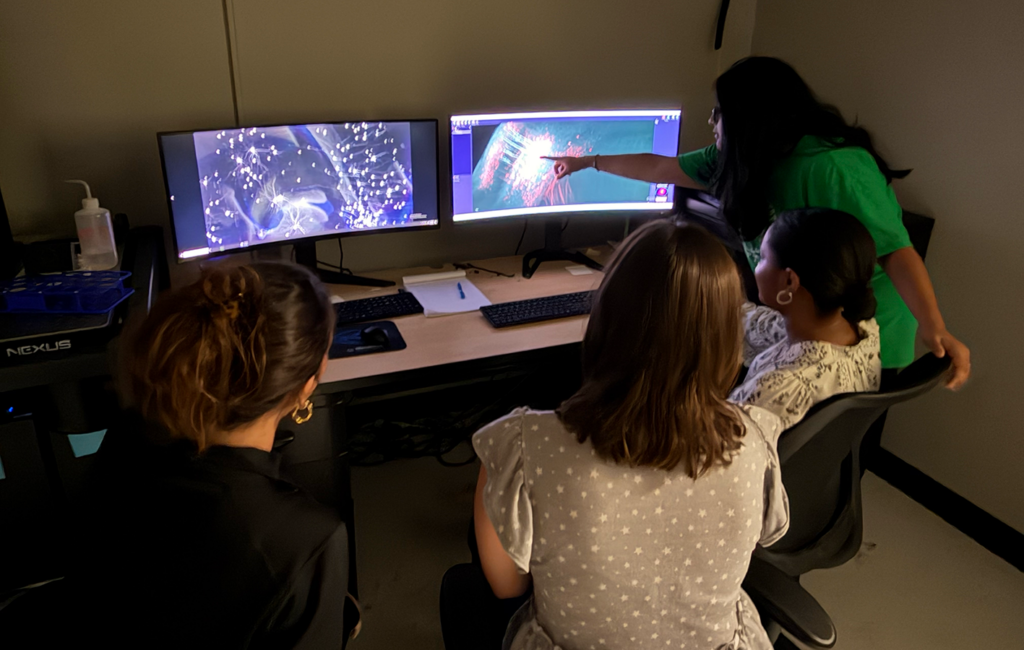
Left to right: Ava Shipman, Emma Sandago, Tatiyana Adkins, and Aditi Buch look at SmartSPIM light sheet data.
What role does light sheet imaging play in your scientific process?
There are a lot of different pipelines we can pursue with whole-brain data, which is great. For one, it gives us a starting point for experiments. You can actually quantify the number of S1 neurons projecting to different brain regions, and the denser those projections are, the more connected those regions are during your behavior of interest. We can home in on the most densely connected regions and explore how those circuits are involved in the behavior.
Outside of this specific paper, we also use whole brain c-FOS imaging to quantify the activation of different brain regions during behaviors. We combine the LifeCanvas c-FOS staining pipeline with FosTRAP transgenic mice to quantify regional neural activation at two different time points. This allows us to identify the brain regions that are instrumental in a specific behavior, which for us is generally stress and drinking.
Beyond this specific circuit, what else are you exploring around the neurobiology of alcohol use and stress?
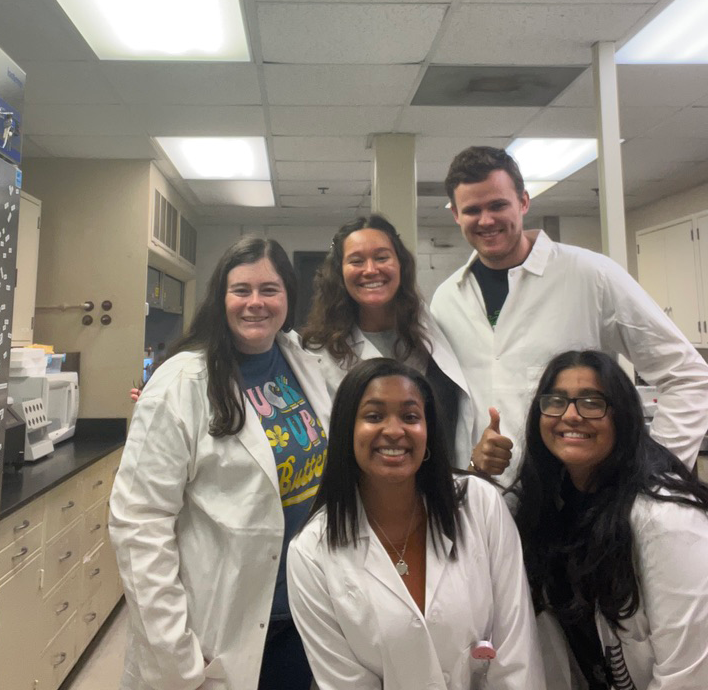
Top to bottom, left to right: Jincy Little, Ava Shipman, Ben Williams, Tatiyana Adkins, and Aditi Buch in the lab.
Our lab explores different models of stress and how it modulates neural circuit function. In this study we focused on the S1-insula circuit during abstinence, a high period of stress. But really, stress can occur at any point in our lives and have lasting impacts on behavior. I am now exploring early life stress effects on adult AUD vulnerability with focuses on insular circuit development and function. I am excited to continue using the LifeCanvas pipeline to investigate the insula and its associated circuits in AUD-related behaviors.